


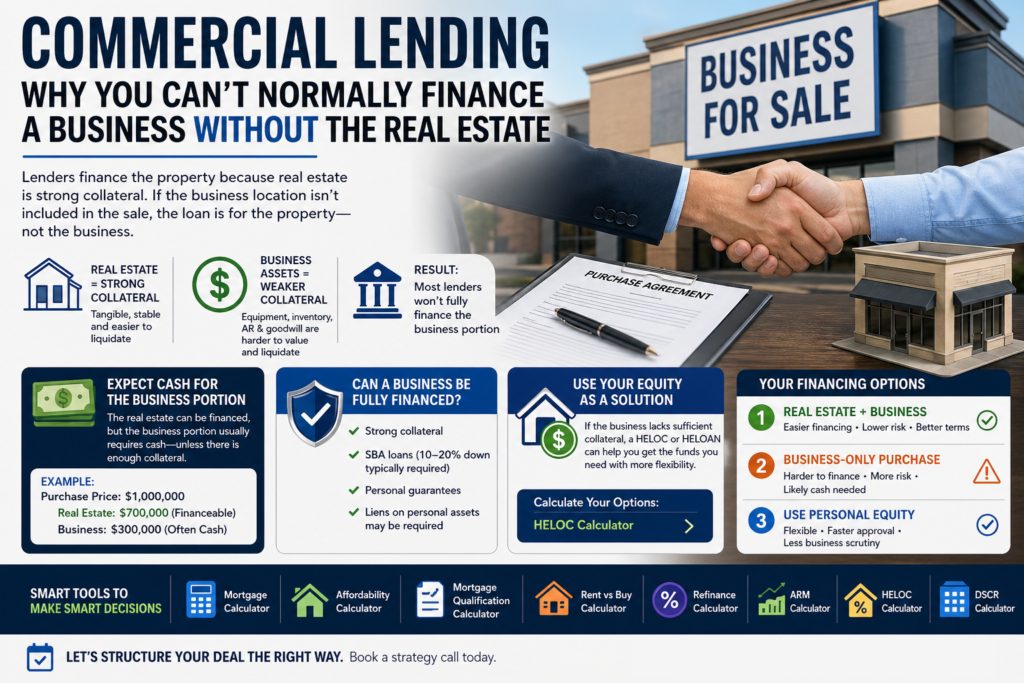
When it comes to commercial lending, one of the most misunderstood concepts is this:
👉 You typically cannot finance just the business unless there’s sufficient collateral—especially if the real estate is not part of the transaction.
Let’s break this down in a way that’s clear, practical, and useful whether you’re a buyer, investor, or entrepreneur.
Why Lenders Prefer Real Estate in Commercial Loans
Commercial lenders are primarily concerned with risk mitigation. The strongest form of collateral in most deals is real estate.
- Real estate is tangible and stable
- It can be appraised and liquidated
- It provides a secured position for the lender
When a deal includes both the business + property, lenders are far more comfortable because:
✔️ The property secures the loan
✔️ The business income supports repayment
✔️ The overall risk is reduced
👉 This is why many commercial loans are structured as “owner-occupied real estate loans” or investment property loans.
If you’re exploring investment-type financing, tools like the
👉 DSCR Calculator
can help you understand how income-producing properties qualify.
The Problem With Financing “Business-Only” Purchases
Here’s where things get tricky.
If you’re trying to buy a business without the property, lenders evaluate:
- Equipment value
- Inventory
- Accounts receivable
- Cash flow history
- Brand goodwill (harder to quantify)
👉 The issue: Most of these are not strong collateral.
Unlike real estate, these assets:
- Depreciate quickly
- Are harder to liquidate
- Carry more uncertainty
Result:
👉 Traditional lenders often won’t fully finance the business purchase.
Expect to Bring Cash for the Business Portion
In many transactions:
- The real estate can be financed
- The business portion often requires cash
Example:
- Purchase Price: $1,000,000
- Real Estate: $700,000 (financeable)
- Business: $300,000 (often cash or partially financed)
👉 Unless:
- The business has strong transferable assets
- OR you provide additional collateral
When Can a Business Be Fully Financed?
There are exceptions, but they require:
1. Strong Collateral
- Additional real estate
- High-value equipment
- Cross-collateralization
2. SBA Loans (Important Correction)
Here’s where I’ll refine your assumption slightly 👇
You mentioned:
“If you’re financing just the business, you’re probably better off using a HELOC or HELOAN.”
✅ That’s often true but not always the only option.
👉 Small Business Administration (SBA) loans can finance business-only acquisitions under certain conditions:
- Strong historical cash flow
- Proven business model
- Experienced buyer
- Good credit profile
However:
- SBA loans still usually require 10–20% down
- May require personal guarantees
- Often include liens on personal assets (including real estate)
So while SBA loans can bridge the gap, they still rely heavily on collateral and borrower strength.
When a HELOC or HELOAN Makes More Sense
If the business lacks sufficient collateral, your strategy is very practical and commonly used:
Use Home Equity
- HELOC (Home Equity Line of Credit)
- HELOAN (Home Equity Loan)
These allow you to:
- Leverage your personal real estate
- Access lower interest rates
- Avoid complex business underwriting
👉 A great starting point is this tool:
HELOC Calculator
And for deeper insight:
👉 Bank Statement HELOC: Flexible Equity Access Without Traditional Income Docs
Comparing Your Financing Options
Option 1: Real Estate + Business Purchase
✔️ Easier financing
✔️ Lower risk to lender
✔️ Better terms
Option 2: Business-Only Purchase
❌ Harder to finance
❌ Requires strong collateral
❌ Likely cash injection needed
Option 3: Use Personal Equity (HELOC/HELOAN)
✔️ Flexible
✔️ Faster approval
✔️ Less business scrutiny
Key Takeaways for Buyers
- Real estate drives commercial lending approvals
- Business-only deals are harder to finance
- Expect to bring cash unless strong collateral exists
- SBA loans can help—but still require structure and strength
- HELOC/HELOAN is often the most practical workaround
Smart Tools to Prepare Before You Apply
Before moving forward, analyze your numbers using:
- 👉 Mortgage Calculator
- 👉 Affordability Calculator
- 👉 Mortgage Qualification Calculator
- 👉 Rent vs Buy Calculator
- 👉 Refinance Calculator
- 👉 ARM Calculator
- 👉 DSCR Calculator
Recommended Reads for Smarter Financing Decisions
- 👉 What Is a DSCR Loan?
- 👉 P&L Loan Program: Qualify Using Your Business Income — Not Your Tax Returns
- 👉 Top Mortgage Mistakes to Avoid as a Homebuyer
- 👉 🚫 Top Reasons Why Loans Get Denied (And How to Avoid Them)
- 👉 When Does It Make Sense to Refinance?
- 👉 Lower Your Payment or Cash Out Your Equity 💰🏡
- 👉 Mortgage Rates, Housing Inventory, and Market Trends
Ready to Structure Your Deal the Right Way?
If you’re considering a business purchase, commercial property, or using equity to fund a deal, getting the structure right upfront can save you time, money, and frustration.